On this page
- What bird is in our photo?
- Why does a titmouse take one piece and immediately leave?
- Where do Tufted Titmice hide the food?
- Why are peanuts and sunflower seeds so attractive?
- Is this the same thing chickadees do?
- Does the titmouse remember where it put all those seeds?
- How can I make a feeder more appealing to Tufted Titmice?
- What should you watch for the next time one visits?
- Sources
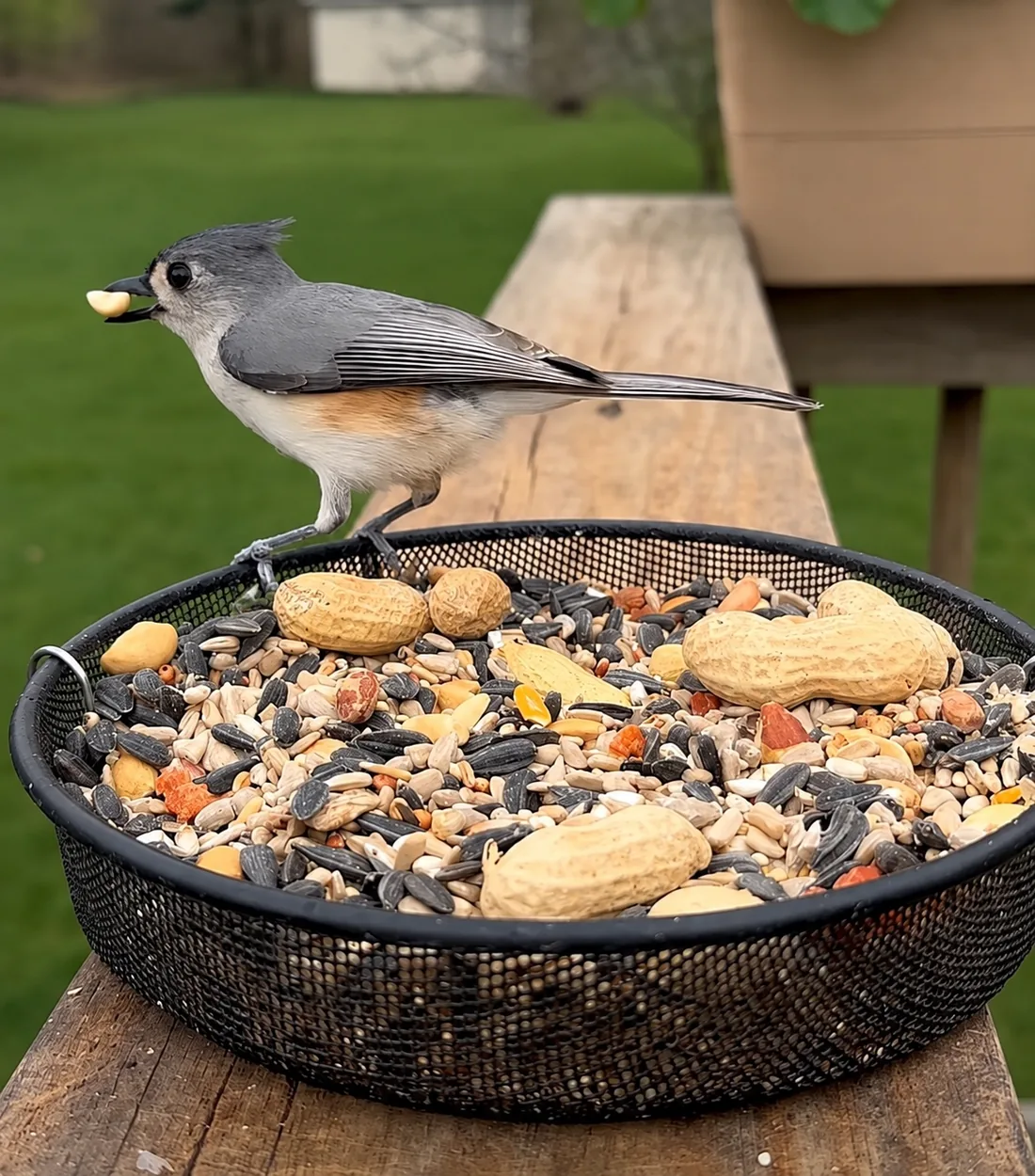
This is exactly the kind of behavior that inspired this guide: the bird arrives, selects one high-value piece of food, and is ready to leave with it rather than settling in for a long meal.
What bird is in our photo?
The bird in our backyard photo is a Tufted Titmouse, a small gray songbird with a prominent pointed crest, large dark eye, pale underside and warm rusty wash along the flanks. In much of the eastern United States, that combination makes the species distinctive around feeders.
The photo captures an especially useful identification clue: behavior. The bird is holding a piece of food at a tray feeder rather than sitting down for a long meal. Tufted Titmice are regular feeder visitors and Cornell lists sunflower seed, peanuts, suet and other seeds among foods they use.
Range matters when identifying any bird. Tufted Titmice are primarily an eastern U.S. species rather than a bird found uniformly across Canada and the United States. If you see a similar crested bird outside the expected range, check a current field guide or Merlin rather than identifying by one feature alone.
Why does a titmouse take one piece and immediately leave?
A feeder is an exposed place. For a small bird, grabbing a valuable item and moving to a nearby branch can let it handle the food with more cover. A titmouse may hold a seed or nut with its feet and hammer it open away from the crowd.
But some of those departures have another purpose: caching. Cornell notes that Tufted Titmice hoard food in fall and winter, storing many of the seeds they obtain from feeders. Instead of consuming everything immediately, the bird can turn a reliable feeder into a supply point for food it will use later.
That makes the behavior look different from birds that remain on a tray and eat multiple pieces in one sitting. Neither strategy is “better.” They reflect different ways species balance food, safety and competition.
Where do Tufted Titmice hide the food?
Cornell reports that storage sites are often within about 130 feet of the feeder. A titmouse may tuck food into bark, crevices or other small hiding places in its surroundings. The exact spot is easy for a human observer to miss because the bird can vanish into nearby trees in seconds.
If you want to watch the process, follow with your eyes rather than approaching the bird. You may see it land on a branch and work on the food immediately, or disappear behind foliage where you cannot tell whether it ate or cached the item.
Do not assume every departure is a cache. Sometimes the bird simply prefers to eat away from the feeder. The important point is that leaving with one item is completely compatible with a feeder the bird values.
Why are peanuts and sunflower seeds so attractive?
High-energy foods make efficient feeder choices. Cornell’s Tufted Titmouse profile specifically notes a preference for sunflower seeds and use of peanuts and suet. A tray containing several foods gives the bird the opportunity to select an item it can carry away.
Our photo shows that choice happening in real time: the feeder contains black oil sunflower seed, mixed seed and peanuts, and the titmouse has selected a pale nut piece. That single image tells a much richer story than a generic portrait because you can see the bird making a food decision.
If you want to offer sunflower seed more broadly, see Black Oil Sunflower Seeds: What Birds Eat Them?. Keep peanuts and seed fresh and dry, and avoid salty, seasoned or candy-coated human snack products.
Is this the same thing chickadees do?
Very similar. Chickadees are close relatives of titmice and are famous backyard grab-and-go feeders. We already cover that pattern in Why Do Chickadees Take One Seed and Fly Away?.
For a beginner, behavior can even create identification confusion: a small grayish bird darts in, takes one seed and leaves before you get a good look. The crest is a major clue for a Tufted Titmouse. A Black-capped Chickadee instead has the familiar black cap and throat patch with white cheeks and no pointed titmouse crest.
The shared feeding style is a great example of why Backyard Bird Answers organizes some content around what people actually notice rather than expecting everyone to know the species first.
Does the titmouse remember where it put all those seeds?
Food caching only works if stored food can be recovered often enough to be useful. Birds that cache food use spatial memory and environmental cues to relocate stores. The exact memory system is a fascinating field of study, but you do not need to imagine a tiny labeled pantry for each seed.
At the backyard level, the takeaway is that titmice are well adapted to using scattered food resources. Your feeder can become one reliable source within a larger landscape of natural foods and stored items.
For the broader feeder-memory question, read Do Birds Remember Where Bird Feeders Are?. A titmouse repeatedly returning to the same productive feeder is a great everyday example of why that question comes up.
How can I make a feeder more appealing to Tufted Titmice?
Start with foods they actually use: sunflower seed, peanuts and suet are all documented feeder choices. A clean hopper, tube or tray setup can work depending on the food and the other animals in your yard. Nearby trees and shrubs provide places to retreat after a quick pickup.
Keep the feeding station clean and avoid allowing old wet food to accumulate. Project FeederWatch emphasizes feeder hygiene because birds congregating around food can spread pathogens. Offer sensible amounts, clean regularly and replace food that has become wet or spoiled.
Habitat helps too. Cornell notes that Tufted Titmice nest in cavities and may use nest boxes where the species occurs. A backyard with mature trees, appropriate native vegetation and cover offers more than a feeder alone.
What should you watch for the next time one visits?
Instead of counting only how many birds are at the feeder, watch the sequence. Does the titmouse inspect several items before choosing? Does it take a sunflower seed one trip and a peanut the next? Does it fly to the same branch? Does it eat there or vanish farther into cover?
Those observations can help you understand why a feeder empties in ways that are not obvious from looking at the tray. A bird may remove food without leaving hulls behind because it is carrying the item elsewhere. Multiply that by many visits and the feeder can drop faster than expected.
That is part of what makes feeder watching so rewarding: the feeder is not merely a bowl of food. It is a window into decision-making. One tiny bird grabbing one peanut and flying away can lead to questions about identification, memory, caching, safety and seasonal behavior—all from a few seconds in the backyard.
Sources & further reading
We use authoritative bird-science and conservation sources for biological claims and established bird publications for practical backyard context. External links are included when they help support or expand on a point.