On this page
Blue Jays already have one of the most noticeable voices in a backyard. Then one produces a call that sounds uncannily like a hawk and the whole scene gets more confusing. You look for a raptor, see nothing, and a Blue Jay drops toward the feeder instead.
That is not your imagination. Blue Jays are documented mimics. Cornell Lab's sound guide says they frequently imitate hawks, especially Red-shouldered Hawks, and Cornell's species overview notes that the calls may convey information about a real hawk or may deceive other species into believing one is nearby.
The interesting part is that knowing they can do it is easier than knowing why this particular jay just did it. Backyard behavior rarely comes with subtitles. The most useful approach is to understand the leading explanations, then watch what happens immediately before and after the call.
Yes, Blue Jays really imitate hawks
Blue Jays have a much larger vocal repertoire than the classic harsh “jeer” many people associate with them. Cornell describes whistles, gurgling sounds, a quiet whisper song and mimicry. Its Blue Jay sound guide specifically says hawk mimicry is frequent.
That matters because a good imitation can fool people who already know what a hawk sounds like. Cornell Bird Academy has even used a Blue Jay imitating a Broad-winged Hawk as an example when explaining the challenge of identifying bird sounds with Merlin. In other words, this is not merely a vague jay scream that people mistake for a raptor. Jays can produce recognizable imitations.
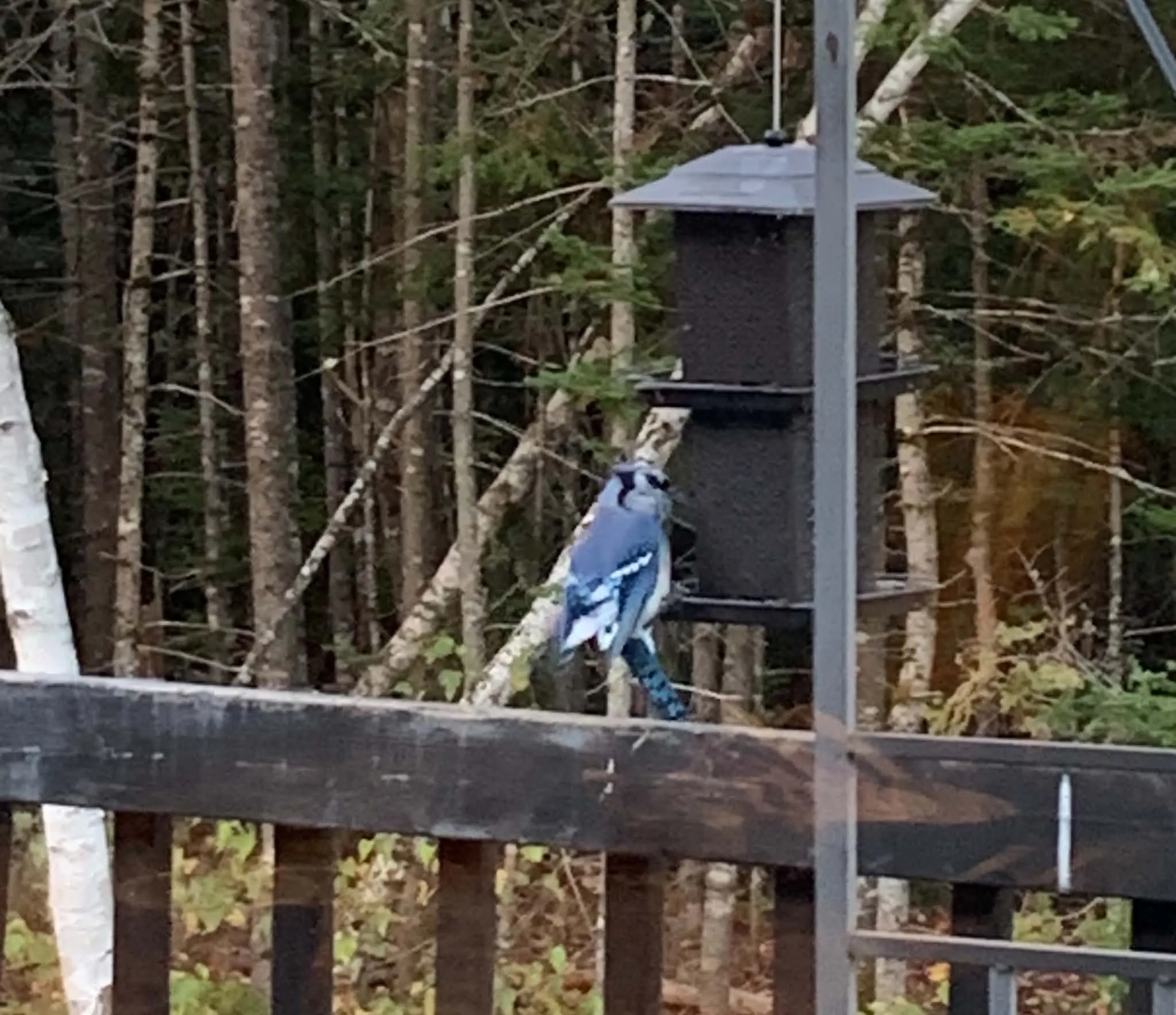
In our own backyard, Blue Jays are among the easiest birds to notice because they are large, bold and conspicuous around the feeder. The original photo above was taken here on the morning of October 7, 2026. A visible jay gives you a useful advantage: when a hawk-like sound occurs, you can sometimes connect the sound with the bird actually making it rather than guessing from behind a wall or closed window.
If the sound you are hearing is simply a loud Blue Jay call rather than obvious mimicry, start with Why Do Blue Jays Scream at My Bird Feeder?. This article is about the narrower question: why a Blue Jay sometimes sounds like another bird entirely.
Which hawks do Blue Jays mimic?
The Red-shouldered Hawk is the species most consistently mentioned in Cornell's public Blue Jay material. Cornell also notes that Blue Jays frequently mimic hawk calls more broadly, and archived Macaulay Library material describes renditions of Red-shouldered, Red-tailed and Cooper's Hawk calls.
That does not mean every hawk-like sound from a Blue Jay can be confidently assigned to a species. Some imitations are more convincing than others. An archived Cornell/Macaulay note describes some renditions as nearly perfect but others as slurred enough to distinguish from the model.
That variation is useful for backyard observers. If you hear what seems like a hawk, do not rely on one syllable or one mental sound effect. Listen for repetition, volume, phrasing and what the bird does next. If you can see the caller, identification becomes much easier.
Why would a Blue Jay mimic a predator?
At first glance it seems backwards. Why would a songbird advertise the sound of an animal capable of attacking birds? The answer is that researchers do not have one proven explanation that accounts for every imitation.
Cornell presents two possibilities worth keeping separate. One is information: a hawk-like call may tell other jays that a hawk is around. Blue Jays are social, vocal birds that respond strongly to threats, so predator-related communication is plausible.
The other is deception: sounding like a hawk may cause other species to behave as if danger is present. Around a concentrated food source, that creates an obvious possible advantage. If smaller birds hesitate or leave, the jay may gain easier access to food.
The important word is may. Seeing a jay call and then seeing another bird leave does not prove a deliberate con. A real predator could be nearby. The smaller bird might have been ready to leave anyway. Or the call may serve a social function among jays that we cannot infer from one backyard encounter.
Do Blue Jays mimic hawks to scare birds away from feeders?
This is probably the most irresistible explanation because it makes such a good story: clever jay imitates hawk, everyone panics, jay gets the peanuts. It is possible that deception sometimes functions that way, and Cornell explicitly includes deception of other species as a possible function of hawk mimicry.
But I would not write “Blue Jays mimic hawks to steal your feeder” as if that were the settled answer. Behavior can have multiple functions, and the same vocalization can occur in different contexts.
If you want to test the idea in your own yard, watch the sequence rather than the sound alone. Does the jay make the hawk-like call immediately before approaching food? Do chickadees or finches leave? Does the jay then take over the feeder? Does this happen repeatedly? Repeated observations are far more informative than one dramatic event.
Blue Jays already have other ways to compete. Their size and assertive approach can displace smaller birds without any mimicry at all. Our guides to why birds chase each other away from feeders and whether birds wait their turn explain how dominance shapes feeder traffic.
How can I tell a Blue Jay imitation from a real hawk?
Sometimes you cannot—not from sound alone. That is part of what makes mimicry effective and interesting. Instead of looking for one foolproof audio trick, combine several clues.
Find the caller. This is the best evidence. Blue Jays often call from exposed branches, and their blue-and-white plumage, crest and black necklace are distinctive when you get a clear view.
Listen to what comes next. A hawk-like note followed by unmistakable Blue Jay jeers, whistles or other jay chatter can reveal the source. Cornell's Blue Jay sound library is useful for learning how broad the species' vocabulary is.
Watch the other birds. If every small bird suddenly dives for cover, take the possibility of a real predator seriously even if a jay is present. Blue Jays themselves may react to actual hawks.
Scan before concluding. A jay can mimic a hawk while a real hawk is also in the area. Seeing the jay does not automatically rule out the predator. Look at treetops, poles and the direction other birds are watching.
Sound-identification apps can help, but mimicry is one reason not to treat an automated identification as absolute. Cornell's Merlin teaching material explicitly demonstrates how a Blue Jay imitation can resemble a hawk recording.
What should I watch when this happens in my yard?
Think like a field observer for thirty seconds. Note where the Blue Jay is perched. Note whether it is alone or with other jays. Watch its crest and posture. Then notice the other species at the feeder and what changes after the call.
A jay giving a hawk-like call while several jays are staring toward the same part of the woods creates one kind of context. A jay calling, dropping immediately to a peanut tray and feeding alone creates another. Neither sequence proves motive, but each gives you more information than the sound in isolation.
Also pay attention to frequency. Does one particular jay seem to do this repeatedly? Does it happen mostly around food? Does it occur when a raptor has been active in the neighborhood? Keeping even a few mental notes can turn a strange sound into a recognizable backyard pattern.
Blue Jays make particularly good birds for this kind of observation because they are so visible. We also see their food-carrying behavior clearly; if yours grabs a peanut and disappears, see Why Do Blue Jays Take Peanuts and Fly Away?.
Does a hawk-like Blue Jay call mean a real hawk is nearby?
Possibly—but not necessarily. If one proposed function of mimicry is communicating the presence of a hawk, then dismissing every imitation as a trick would be just as simplistic as assuming every imitation proves a hawk is present.
Use the rest of the backyard as your evidence. Songbirds that abruptly freeze, dive into cover or vanish can indicate a disturbance. A jay mobbing or focusing intensely on one location may also deserve a look. On the other hand, normal feeding continuing around a relaxed jay provides less reason to assume immediate danger.
If a hawk actually attacks near your feeder, the feeder may go quiet afterward. That is a separate problem covered in Will Birds Come Back After a Hawk Attacks My Bird Feeder?.
Hawk mimicry is one piece of a very complicated bird
Blue Jays belong to the corvid family, alongside crows and ravens, and their behavior is often more complicated than the “loud bully” stereotype suggests. Cornell describes tight family bonds, complex social systems, food caching and a diverse vocabulary. Hawk mimicry fits that broader picture of a highly observant, communicative bird.
That does not require turning every Blue Jay into a tiny criminal mastermind. The more interesting answer is also the more accurate one: Blue Jays really do imitate hawks, scientists have plausible ideas about what the behavior can accomplish, and the exact function of a particular call depends on context we may not fully know.
So when a hawk seems to be calling from your backyard and a Blue Jay is sitting suspiciously close to the feeder, keep looking. You may be hearing one of the strangest—and most convincing—performances at your feeding station.
Best next reads
Common questions
Do Blue Jays really imitate hawks?
Yes. Cornell Lab documents Blue Jays frequently mimicking hawks, especially Red-shouldered Hawks.
Why do Blue Jays make hawk sounds?
Possible functions include alerting other jays to a hawk or deceiving other species into behaving as if a hawk is nearby. The motive behind one specific call is usually uncertain.
Can a Blue Jay fool Merlin or a bird-sound app?
Mimicry can make sound identification difficult. Cornell Bird Academy has demonstrated a Blue Jay imitating a Broad-winged Hawk when discussing Merlin's sound-classification challenges.
Do Blue Jays imitate hawks to steal food?
They may sometimes gain an advantage if other birds respond to the imitation, but it is too strong to claim that every hawk imitation is a deliberate feeder-clearing trick.
Does a Blue Jay hawk call mean a hawk is nearby?
Not necessarily. A real hawk may be present, but Blue Jays can produce hawk-like calls without giving you proof that a predator is currently in the yard.