On this page
- What Downy Woodpeckers eat in the wild
- Why suet is such a good feeder food
- Do Downy Woodpeckers eat sunflower seeds?
- Will they eat peanuts and other foods?
- What our backyard photo shows
- Downy or Hairy Woodpecker?
- Where to place a feeder for Downy Woodpeckers
- What changes with the seasons?
- What if larger birds take all the suet?
- Why a Downy Woodpecker might ignore your feeder
- Make the whole yard more useful
- What to watch on the next visit
- A few feeding mistakes to avoid
- Common Downy Woodpecker feeding questions
What Downy Woodpeckers eat in the wild
Downy Woodpeckers are insect hunters first. They probe cracks in bark, inspect branches, and work through stems to find beetles, ants, caterpillars, and larvae hidden from view. Their short, pointed bill and light body let them search places larger woodpeckers may not use as easily.
Cornell Lab describes insects as the main part of their diet, with plant foods such as berries, acorns, and grains making up a smaller share. That is an important correction to the idea that woodpeckers live entirely on seeds or peck wood because they enjoy the sound. Much of their quiet tapping and probing is a search for living food.
In late summer and fall, Downies may inspect weed stems and dried flower stalks for insects. Leaving some native stems standing can create natural foraging opportunities. A tidy feeder helps, but a backyard with trees, shrubs, and insect habitat may offer much more than a single food source.
Why suet is such a good feeder food
Suet provides concentrated energy and is easy to present in a hanging cage. Downy Woodpeckers can cling to the wire and peck at small pieces while keeping their feet secure. Cornell identifies suet as a preferred feeder offering, which is why a simple suet cage is often the first recommendation for attracting this species.
Choose a product intended for wild birds, place it where the bird can approach without being trapped in a crowded feeding station, and keep the holder clean. Suet can spoil or soften in hot weather; follow the product's temperature and storage directions, replace questionable food, and avoid leaving rancid blocks outside.
A feeder with a tail prop gives some woodpeckers extra support, but a Downy is small enough to use ordinary cages too. If the bird visits briefly and leaves, that does not mean it disliked the food. It may be moving between several feeding locations or checking for predators.
Do Downy Woodpeckers eat sunflower seeds?
Yes. Black oil sunflower seeds are a well-documented feeder food for Downy Woodpeckers. Their relatively thin shells and high-energy kernels make them useful to many backyard birds, so the Downy may visit a feeder already busy with chickadees, nuthatches, and finches.
You may see a woodpecker cling to the side of a mesh or tube feeder, take a seed, and move to a branch. A woodpecker is not obligated to remain at the feeding port and eat in full view. Some birds take food to a more comfortable perch before handling it.
If you are deciding what seed to buy, our black oil sunflower seed guide explains which other birds use it. Keep the seed dry, clean the feeder, and discard wet or spoiled contents rather than hoping birds will eat around the bad patches.
Will they eat peanuts and other foods?
Downy Woodpeckers may take peanuts, especially small unsalted pieces offered in a suitable feeder. Use plain peanuts intended for bird feeding rather than salted, seasoned, or candy-coated human snacks. Avoid putting out large quantities that become wet, moldy, or attractive to rodents.
Cornell also notes that Downies sometimes visit hummingbird or oriole feeders, but that occasional behavior should not be mistaken for their main diet. Sugar water does not replace the insects and other foods they normally find in their habitat.
A few kinds of bird food are enough. You do not need an elaborate buffet to make your yard attractive. Start with clean suet and sunflower seed, then see what the bird actually uses. If it ignores peanuts, there is no reason to keep buying them solely for this species.
What our backyard photo shows
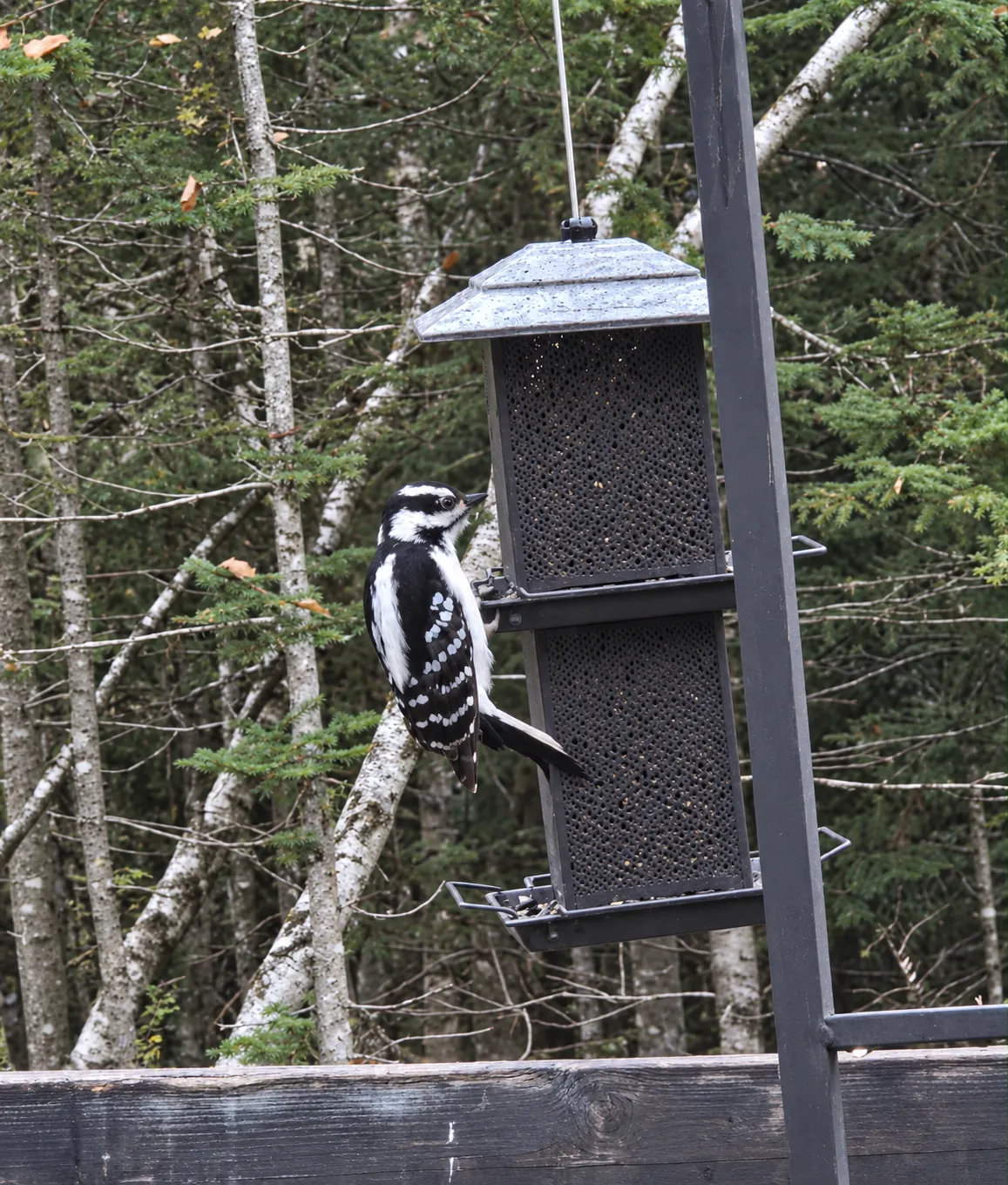
The photograph at the top of this article captures a small black-and-white woodpecker clinging vertically to the side of a mesh feeder in a wooded backyard. The bird's compact size, short bill, white back markings, and spotted wings are consistent with a Downy Woodpecker. The photo was shared after a morning feeder visit in October 2026.
The bird is gripping the feeder beside the seed ports rather than standing on a tray. That is a useful detail: Downies are built for clinging, and a feeder with a textured or mesh surface can offer a place to hold on while they investigate food. The image alone does not establish exactly which seed the bird took or whether it was feeding continuously.
A close view like this makes a species guide more practical. Instead of assuming every woodpecker requires a huge specialized feeder, you can see that a small Downy may investigate an ordinary backyard feeding station.
Downy or Hairy Woodpecker?
The most common lookalike is the Hairy Woodpecker. Both are black and white, and both may have a red patch on the back of a male's head. Size and bill proportions are usually more useful than color alone. A Downy is noticeably smaller and has a short, stubby-looking bill; a Hairy is larger with a bill closer to the length of its head.
A photograph with the feeder for scale can help, although feeder sizes vary. Watch the bill shape and overall proportions rather than deciding from one white spot. Juvenile birds and viewing angles can complicate identification.
For a reliable side-by-side comparison, use Cornell Lab's identification guide and listen to the calls when possible. The Downy's whinny and sharp notes differ from some similar-sounding woodpecker calls, but a brief backyard visit may not include any sound at all.
Where to place a feeder for Downy Woodpeckers
A suet cage near trees or shrubs can be inviting because it resembles the vertical surfaces a Downy already explores. Give the bird a clear approach and a route back to cover, while avoiding a spot where a cat can hide immediately beside the feeder.
If you hang the feeder beside a window, take collision risk seriously. Placement and visible glass treatments matter more than getting the perfect photograph. Keep the feeder reachable for regular cleaning and away from areas where food scraps collect unnoticed.
You can try one suet cage rather than several. Watch from indoors or at a distance and let the bird learn that the food source is dependable. Repeated rearranging may make it harder to tell whether a change helped.
What changes with the seasons?
In spring and summer, insects are abundant in many places, and Downies may spend much of their time feeding naturally or provisioning young. In colder weather, suet and seeds can become more noticeable parts of backyard feeding activity, although insects remain important wherever they can be found.
The bird's presence can also change with local territory, competition, weather, and how much natural food is available. A quiet suet cage in June does not prove that the species has left your neighborhood. You may simply be seeing a different part of its daily routine.
Downy Woodpeckers occur year-round across much of their North American range. Rather than expecting identical visits every day, look for patterns over weeks and seasons. Record whether the bird visits after sunrise, during colder spells, or when other feeder traffic is light.
What if larger birds take all the suet?
Starlings, squirrels, and larger woodpeckers may dominate an open suet cage. If the Downy is being displaced, try moving the feeder to a quieter location, using a smaller access design, or choosing a cage designed to reduce access by larger birds. No feeder is guaranteed to exclude every unwanted visitor.
Avoid using sticky substances, exposed fishing line, or other improvised barriers that could entangle wildlife. Clean up dropped suet and replace food that has become dirty. If squirrels are the main issue, a properly installed baffle may help depending on the feeder mount.
Our article on birds chasing other birds away explains why crowding and competition can change which species gets a turn. A small woodpecker may simply wait until the feeding station is calmer.
Why a Downy Woodpecker might ignore your feeder
First, it may already be finding plenty of insects. Second, it may not recognize a new suet cage immediately. Third, the food may be old, poorly placed, or difficult to access. Fourth, nearby movement or a predator may make the location feel unsafe. None of these possibilities can be proven from one missed visit.
Check the basics before changing everything: fresh food, a stable feeder, a clear approach, and a reasonable distance from busy human activity. Give the bird time to discover the offering. If you see it working bark on a nearby tree, that is natural feeding behavior, not a failure of your feeder.
For general advice on the waiting period after installing a new feeder, see How Long Does It Take Birds to Find a New Feeder?. The Downy may return when it is ready.
Make the whole yard more useful
A feeder is only one piece of the habitat. Native trees, dead branches that can be retained safely, shrubs, and standing plant stems can support insects and create places for woodpeckers to forage. Avoid unnecessary insecticide use, which can reduce the very food the birds are looking for.
Dead trees can be valuable wildlife habitat, but a hazardous snag near a home, walkway, or power line requires professional assessment. Do not keep dangerous wood standing solely to attract birds. Smaller safe dead branches or native plants may offer habitat without creating a structural risk.
Water also matters. A clean, shallow bird bath gives many species another reason to visit, and you do not need a fountain to provide it. If you are considering one, our solar bird bath fountain guide explains the practical trade-offs.
What to watch on the next visit
When the Downy returns, look for three things before changing your setup. First, does it peck at a port, inspect the mesh, or simply pause on the feeder? Second, does it carry food away to a nearby branch? Third, do larger birds interrupt the visit? Those details help distinguish food preference from feeder access and competition.
A photo sequence can be especially useful. One image shows the bird's posture; a second might reveal whether it actually removed a seed. Avoid assuming a bird ate a particular ingredient because it happened to land on a mixed-seed feeder. If the feeder contains several foods, the photograph alone cannot identify its choice.
Keep a simple note of date, weather, food offered, and behavior. A handful of real observations can make future articles more grounded without pretending one backyard is a controlled experiment.
A few feeding mistakes to avoid
Never put out salted nuts, heavily seasoned scraps, or food that has become moldy. Do not smear sticky foods over a bird's feathers or bill, and do not place suet where it melts into an oily mess. If using peanut butter, follow reputable bird-feeding guidance and offer it appropriately rather than leaving a thick exposed coating that collects debris.
Clean feeder surfaces regularly, wash hands after handling feeders, and avoid letting old food accumulate beneath them. If a bird appears sick, pause feeding and follow local wildlife health guidance. Healthy feeding habits benefit the whole backyard community, not just the Downy you hoped to attract.
A woodpecker does not need to eat from your hand or approach people closely. Let it keep its normal distance and move naturally between trees and the feeder.
Common Downy Woodpecker feeding questions
What is the best food to attract Downy Woodpeckers?
Suet is an excellent starting point. Black oil sunflower seeds are another well-supported option.
Do Downy Woodpeckers eat peanuts?
Yes, they may take plain unsalted peanuts or pieces offered in an appropriate feeder.
Do Downy Woodpeckers eat insects?
Yes. Insects and larvae are the main part of their natural diet.
Do they eat from regular seed feeders?
They can. Their clinging feet let them use some mesh and tube feeders as well as suet cages.
Are Downy Woodpeckers here in winter?
Across much of their range, yes. They are familiar year-round residents, though local patterns vary.
Should I put suet out in summer?
You can, but choose products appropriate for warm weather, check them often, and remove anything softening or spoiling.